


Hotel Financing in the UK: A Practical Guide for Investors and Developers
The hospitality sector remains an important component of the UK real estate market. With millions of international visitors each year and strong domestic tourism, hotels continue to attract interest from property developers, investors, and hospitality operators.

The hospitality sector remains an important component of the UK real estate market. With millions of international visitors each year and strong domestic tourism, hotels continue to attract interest from property developers, investors, and hospitality operators.
However, hotel projects often require significant capital investment, whether for acquiring an existing hotel, renovating a property, or developing a new hospitality asset. As a result, hotel investors frequently rely on specialised financing solutions to fund these projects.
This guide explores hotel financing in the UK, including the types of funding available, key lender requirements, and how structured finance specialists such as ROSCAP help investors secure the capital required for hospitality developments.
Understanding Hotel Financing
Hotel financing refers to funding solutions designed to support the acquisition, development, refurbishment, or expansion of hospitality properties.
Hotels are considered a specialised asset class, which means lenders evaluate them differently from residential or standard commercial property investments. This is because hotel performance depends heavily on operational factors such as occupancy rates, management quality, and tourism demand.
Typical hotel financing solutions may include:
● acquisition finance for purchasing existing hotels
● development finance for new hotel construction
● refurbishment funding for upgrading hospitality assets
● bridging loans for short-term property acquisitions
The appropriate financing structure will depend on the scale and complexity of the project.
Why Investors Are Interested in Hotel Investments
Hotel investments can offer attractive returns when managed effectively. Several factors continue to attract investors to the hospitality sector.
Growing Tourism Demand
The UK remains one of the most visited destinations in the world. Cities such as London, Edinburgh, Manchester, and Birmingham consistently attract international visitors, business travellers, and domestic tourists.
This demand helps support strong occupancy rates for well-located hotel assets.
Value-Add Opportunities
Hotel properties often present opportunities for value creation through:
● refurbishment and repositioning
● brand conversion or franchise partnerships
● improved operational management
● expansion or redevelopment
These strategies can significantly increase revenue potential.

Diversification
For real estate investors with residential or commercial portfolios, hotels provide an opportunity to diversify into a different asset class that is driven by hospitality demand rather than traditional leasing structures.
Types of Hotel Financing Available
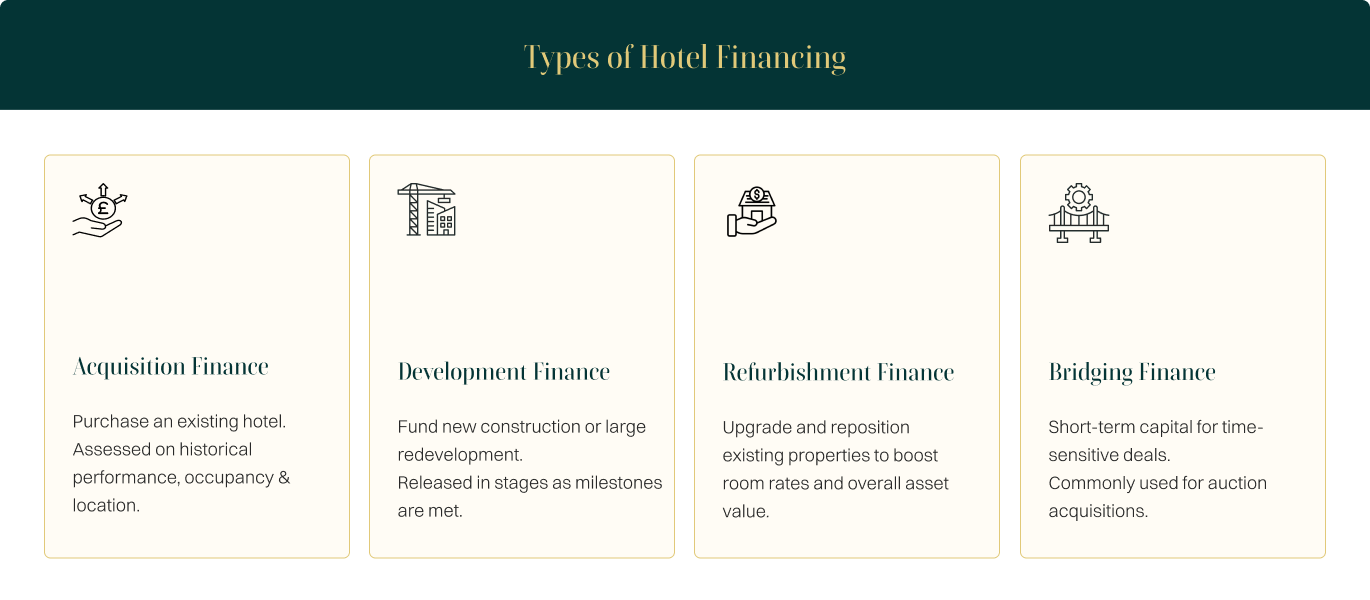
There are several types of funding structures commonly used for hotel projects.
Acquisition Finance
Acquisition finance is used to purchase an existing hotel property.
Lenders typically assess:
● the hotel’s historical performance
● occupancy rates and revenue
● location and market demand
● management experience of the operator
This type of financing may be structured as a commercial mortgage or hospitality loan.
Term Loans, Investment Loans, and Commercial Mortgages
For investors seeking long-term financing for hotel properties, term loans, investment loans, or commercial mortgages are commonly used funding structures.
These financing solutions are typically arranged once a hotel property has been acquired or stabilised and can support longer-term ownership strategies.
Unlike short-term financing such as bridging loans, term-based hotel financing generally offers longer repayment periods and structured amortisation schedules, making it suitable for established hospitality assets generating consistent revenue.
Lenders providing term loans or commercial mortgages will usually assess several key factors, including:
● the hotel’s operational performance
● occupancy rates and revenue stability
● the property’s location and market positioning
● the experience of the operator or management team
● the overall financial strength of the borrower
Investment loans for hotels may also be structured around projected cash flow from the property. In these cases, lenders analyse hospitality performance metrics such as Average Daily Rate(ADR) and Revenue per Available Room (RevPAR) to evaluate the property's ability to support long-term debt.
For investors who plan to hold hotel assets over an extended period, commercial mortgage financing can provide stable funding aligned with the long-term income profile of the property.
Development Finance
Development finance is used to fund the construction of new hotels or large-scale redevelopment projects.
Funding is usually released in stages as construction milestones are completed.
Typical considerations include:
● project feasibility
● construction costs
● projected revenue after completion
● developer experience
Hotel development finance is often more complex than standard property development funding due to operational considerations.
Refurbishment and Repositioning Finance
Many hotel investors acquire properties that require upgrades or repositioning.
Refurbishment financing can be used to fund improvements such as:
● room renovations
● upgraded amenities
● brand repositioning
● energy efficiency improvements
These improvements can increase room rates and overall property value.
Bridging Finance
Bridging loans provide short-term funding, often used when investors need to secure a property quickly.
This type of finance is commonly used for:
● hotel acquisitions at auction
● time-sensitive purchases
● short-term funding before securing long-term financing
Bridging finance typically has shorter terms but can be arranged quickly.
Key Factors Lenders Consider in Hotel Financing
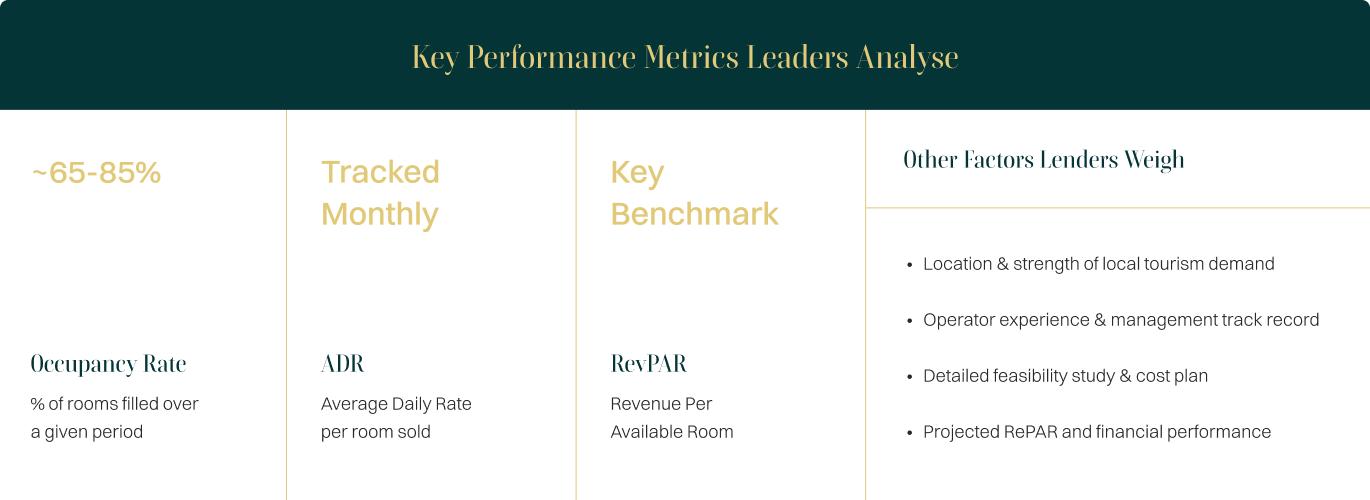
Because hotels are operational businesses as well as property assets, lenders assess several factors before providing funding.
Location and Market Demand
Hotels in established tourism or business destinations are generally viewed as lower risk.
Lenders will consider local demand drivers such as:
● tourism activity
● transport connectivity
● nearby attractions or business districts
Operator Experience
The experience and track record of the hotel operator or management team are important factors in financing decisions.
Strong operational expertise can improve lender confidence in the project’s long-term success.
Revenue Performance
Lenders typically analyse key hotel performance metrics such as:
● occupancy rates
● average daily rate (ADR)
● revenue per available room(RevPAR)
These indicators help assess the financial viability of the investment.
Project Feasibility
For new developments, lenders review detailed feasibility studies, including:
● development costs
● expected construction timeline
● market demand forecasts
● projected financial performance
A well-prepared business plan can significantly improve the chances of securing financing.
Challenges in Hotel Financing
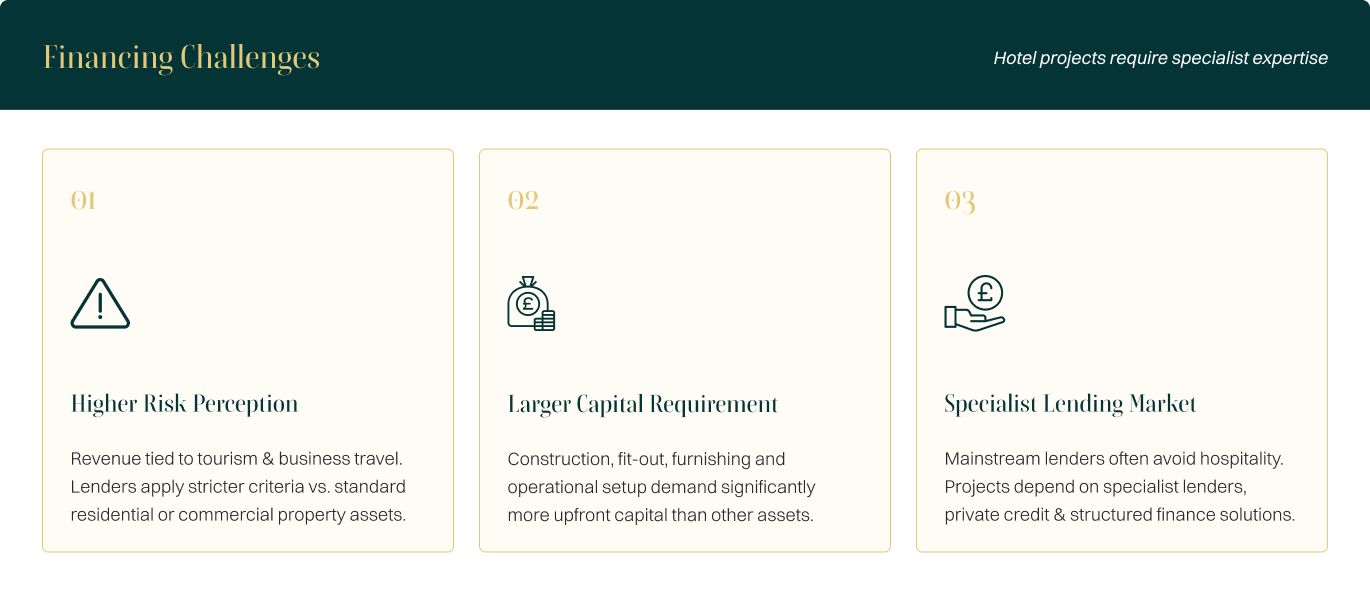
Hotel financing can be more complex than other types of property funding due to the operational nature of the asset.
Higher Risk Perception
Because hotel revenue depends on tourism and business travel, lenders may view hospitality assets as higher risk compared to residential property.
Larger Capital Requirements
Hotel projects often require significant capital due to construction costs, operational setup, and furnishing requirements.
Specialist Lending Market
Not all lenders finance hospitality assets. Many hotel projects rely on specialist lenders, private credit funds, or structured finance solutions.
How ROSCAP Supports Hotel Financing
Structuring financing for hotel projects often requires specialist expertise.
ROSCAP works with property developers and investors to structure and arrange financing solutions for complex real estate projects, including hospitality assets.
Rather than lending directly, ROSCAP focuses on connecting borrowers with suitable funding sources and structuring capital solutions tailored to each project.
This may include:
● development finance for hotel construction
● bridging finance for acquisitions
● structured funding for complex hospitality projects
● capital sourcing from lenders and private credit funds
By designing appropriate financing structures, ROSCAP helps developers and investors move hotel projects forward efficiently.
Learn more about ROSCAP’s approach to property finance and services.
FAQs
Can hotels be financed through commercial mortgages?
Yes. Many lenders provide commercial mortgage products specifically designed for hotel acquisitions.
Is hotel development finance available in the UK?
Yes. Specialist lenders offer development finance for new hotel construction and large refurbishment projects.
What deposit is typically required for hotel financing?
Deposits can vary, but lenders often require 30–40 % equity depending on project risk.
Are hotel projects considered higher risk by lenders?
Hotels are operational assets, so lenders typically conduct more detailed assessments compared to standard property investments.
Can hotel investors use bridging finance?
Yes. Bridging loans are often used for quick hotel acquisitions or short-term funding before securing long-term financing.